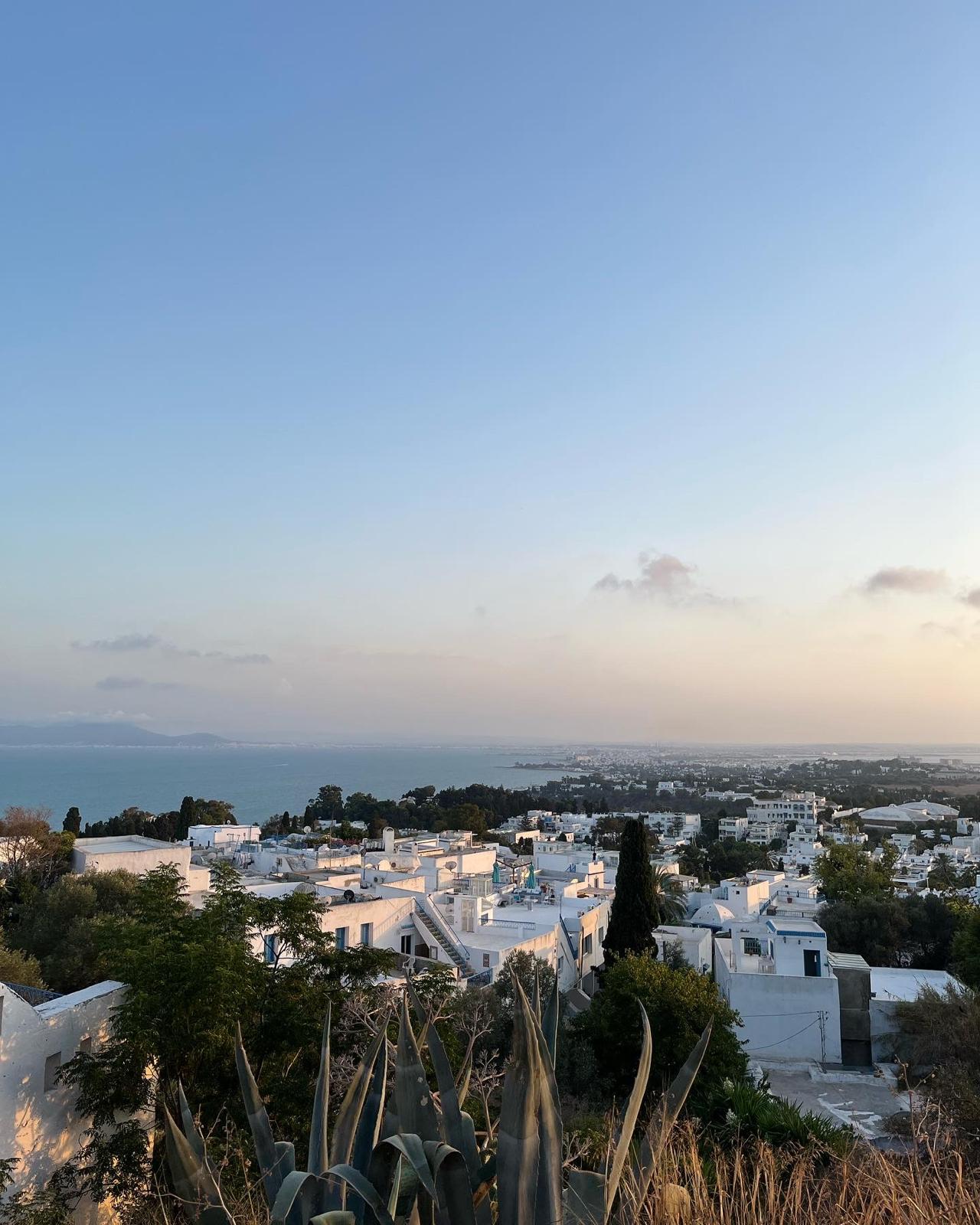
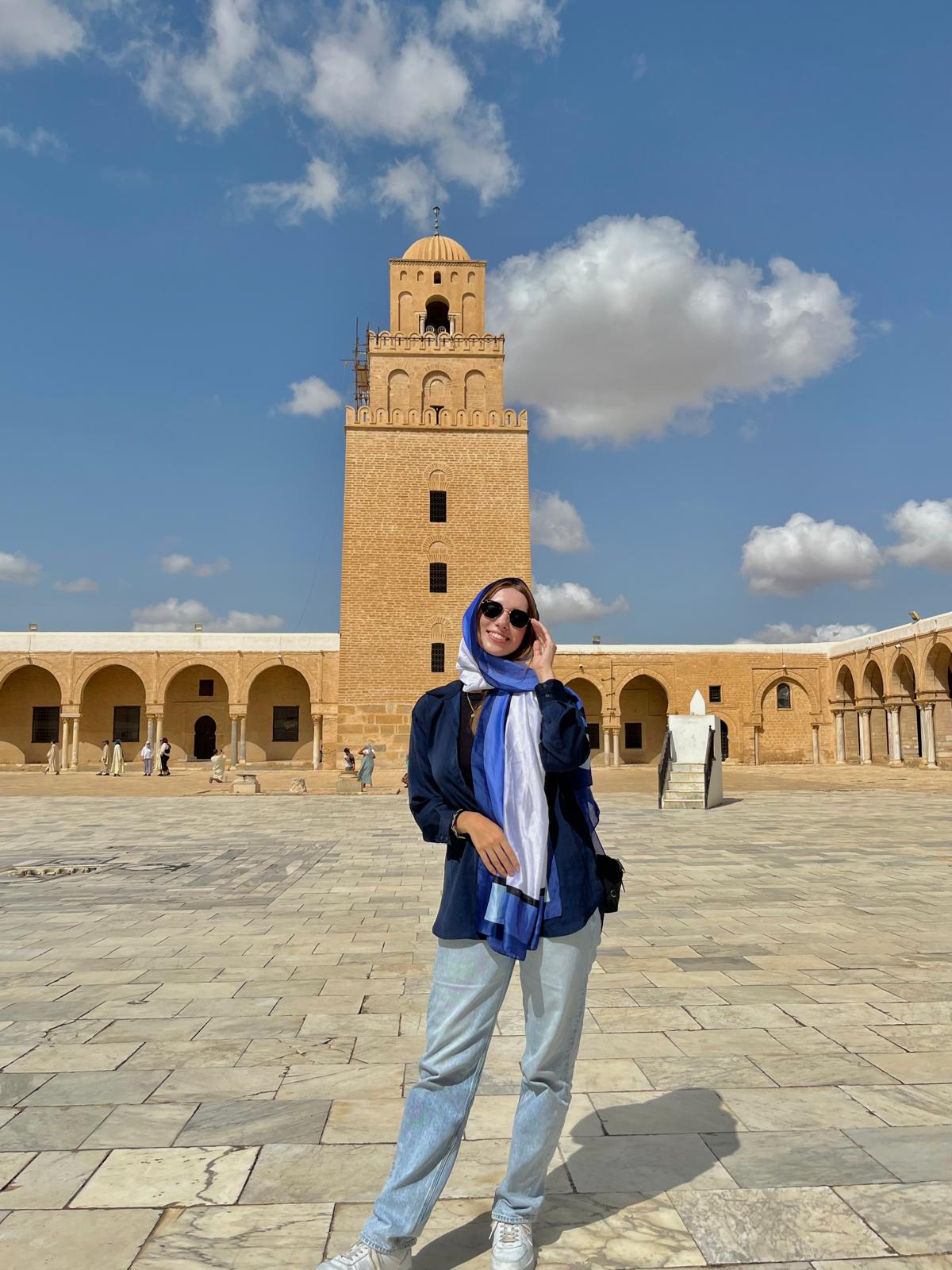
I spent, in total, perhaps four months in Tunisia. It left a deeper mark than places I’ve lived for years.
Arriving
I came to Tunis in the autumn of 2022 through the School for International Training’s programme on Politics and Religious Integration in the Mediterranean - a semester split between Tunisia and three weeks in Sicily studying migration flows. I wasn’t originally supposed to be in that program, having initially chosen a program in Dakar, Senegal, on Religious Pluralism and Global Security that was cancelled preemptively due to low enrollment. I was freshly twenty, halfway through my degree at Occidental, and I had spent the previous two years independently curating my interest in religion, nationalism, and political identity, having yet to take a class about the intersection of such topics. Tunisia was the first place where those subjects not only became analytical categories, but, more importantly, became the texture of daily life.
The programme was academically rigorous, but what made it transformative was everything that happened around the formal curriculum. Walking through the medina, navigating conversations in a mixture of French and fragments of the Tounsi dialect I was beginning to pick up, sitting in cafes in La Marsa while journaling and chatting with locals and classmates alike - these weren’t breaks from the learning. Rather, they were part of it, and often the most formative parts of my learning. Understanding how political Islam reshaped women’s lived experience after the 2011 Jasmine Revolution required more than reading about it. It required being in the places where it happened, listening to the people it happened to, and doing so in their languages and on their terms.
The Research
My independent research in Tunis, supervised by Dr Raja Boussedra, focused on how women in the suburbs of Tunis experienced the impact of Political Islam and Salafism on their rights in the years following the Jasmine Revolution. I collected questionnaire responses in English and French, conducting research that required not just linguistic facility but genuine sensitivity to the fact that I was asking women to speak about deeply personal experiences of political and religious change with a foreign researcher. Being cognizant of my positionality in this work was essential, and a regular topic of conversation with Dr Boussedra as I progressed in my research.
That fieldwork shaped everything that came after. My MPhil dissertation on gendered rhetoric in right-wing movements across the US and UK was, in many ways, an extension of what I first encountered in Tunis - the realisation that the relationship between gender, religion, and political power is not a niche academic interest but a structural feature of how exclusionary movements operate everywhere. Tunisia is where that understanding moved from theoretical to felt.
The research also taught me something about methodology that I carry into all my work now: the gap between what frameworks describe and what people actually experience. The women in the suburbs of Tunis live inside political and religious dynamics that international observers described in one set of terms and that they themselves described in another. Learning to hold both of those descriptions simultaneously - to take the institutional analysis seriously without letting it overwrite the lived reality - is a skill I developed in the streets of La Marsa.
Coming Back
After finishing my master’s at Trinity College Dublin, I spent several weeks interrailing through Europe before heading back to Seattle. At the end of that trip, I didn’t go straight home. I went back to Tunis.
It wasn’t a research visit, nor was it planned super far in advance. I reunited with another friend of mine from the same SIT program, both of us sharing the strong desire to be there again. I wanted to walk through the medina, sit in La Marsa, hear the call to prayer over the rooftops, and spend time in a place that had reshaped how I think about the world. The fact that I was drawn back - that Tunisia pulled me in even when there was no institutional reason to return - says something about what the place means to me that’s harder to articulate in academic language.
There’s a particular quality to Tunis that I haven’t found anywhere else. The warmth and openness of the people, the way the city holds layers of history without making a museum of itself, the architecture that moves between Ottoman, French colonial, and modern in the space of a single street. Then there’s Carthage - sitting quietly on the coast, one of the most consequential cities in human history. The Punic Port remains to this day, and I took time on this recent trip to visit the port alongside several other historical sites that made Carthage the historical behemoth it was. Many people had no idea where or what Tunisia was when I first told them where I was studying, but could recognise the name Carthage from their middle school history class when I mentioned it. That gap between what a place is and what the world knows about it resonates with me. A lot of my research is about exactly that kind of gap - the distance between reality and the narratives constructed around it.
What I Carry
Tunisia is present in my daily life in ways that might not be obvious from my CV. I wear jasmine oil on my wrists and a Hand of Fatima around my neck. My French absorbed phrases from the Tounsi dialect that surface without my thinking about them. I am extremely discerning about the harissa I buy, and cous cous has become a staple at home. These aren’t affectations or souvenirs; they’re traces of a place that became part of how I move through the world.
Bluntly speaking, a lot of people in the Global North are often raised with certain preconceived notions about the MENA region, many of which are negative, exaggerated, or misconstrued. Though I had done my best, through my education, to deconstruct any perceptions such an upbringing left me with, Tunisia shattered the remaining paradigm. It made me acutely aware of what was said about that part of the world, with several people asking me if I felt safe on the streets of Tunis. I always respond that I felt safer in Tunis than in Italy, a fact that seemed to surprise many. When I think of how the media in our part of the world constructs narratives about the MENA region, however, I am unsurprised by this perception. Tunisia brought to life the difference between narrative and reality in a way that the classroom cannot.
I think what draws me to Tunisia so strongly, despite having spent relatively little time there compared to the other places I’ve called home, is that it’s the place where the things I care about most intellectually first became real to me. Australia is where my curiosity began. Seattle is where I grew up. Los Angeles and Dublin are where I was educated. Tunis, however, is where I first stood inside the questions I study - where gender, religion, political power, and the gap between institutional frameworks and human experience stopped being subjects and became something I could see and hear and sit with.
That matters more than the number of months I spent there.
From the archive
Gallery
Scenes from Tunisia that carry the atmosphere of return as much as the memory of fieldwork.